


Fingernails are often treated as accessories to be polished, shaped, and buffed but from a dermatologic perspective, they’re complex structures with their own health needs, often letting us know there is something else going on within our bodies. In fact, nails aren’t separate from skin at all. They’re made of the same keratin proteins, supported by the same network of blood vessels and nerves, and depend on the same systems—hydration, barrier integrity, circulation, and nutrient delivery—to stay healthy.
They’re also more complex than you might think, with several interdependent parts:
- Matrix: Located beneath the skin at the base of the nail, the matrix is responsible for producing the nail plate.
- Nail plate: The hard surface made of compressed keratin that extends over the fingertip.
- Nail bed: The layer of tissue beneath the plate that supplies nutrients and blood flow to the growing nail.
- Lunula: The pale half-moon is sometimes visible at the base of the nail; it marks the visible portion of the matrix.
- Cuticle: A thin strip of tissue that seals the opening between the nail and the surrounding skin, forming a barrier that helps prevent infection.
Now that you’re more familiar with the individual nail structures, we’ll examine how even minor disruptions in the tissue can manifest on the surface and what underlying biological concerns they may reflect. Along the way, we’ll introduce three levels of clinical-grade nail care—topical treatments, matrix-targeted supplements, and barrier-repair formulas—designed to support healthier growth.
Peeling or Flaking at the Tips
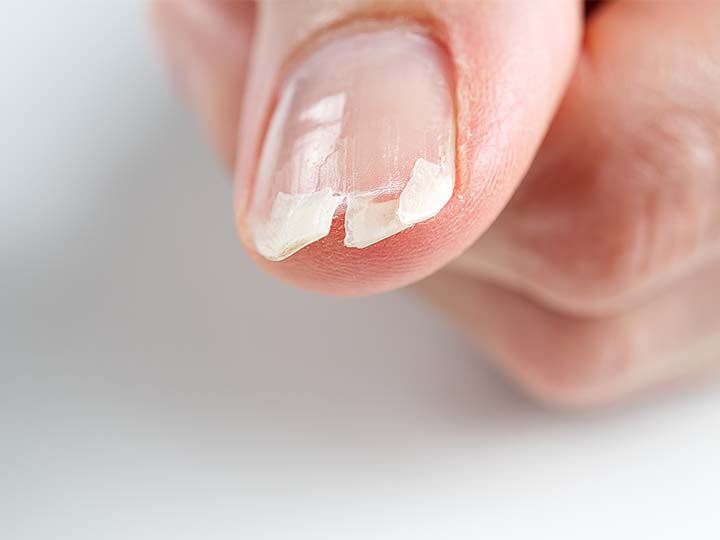
Horizontal splitting of the nail plate, resulting in peeling or flaking, is called Onychoschizia. This is one of the most common nail concerns, particularly in individuals who frequently wash their hands or are exposed to acetone. It usually appears at the free edge, where the topmost layers of the nail begin to lift and separate in thin, translucent sheets.
Like the outer layer of our skin, the nail plate relies on lipids to act like a kind of mortar between keratin cells. When they’re stripped away by solvents like acetone or frequent hand washing, the plate begins to delaminate (separate), and once that bond is lost, the nail can’t reseal itself. Without restoring both surface hydration and healthy growth at the matrix, you’ll likely see that the same peeling tends to repeat with every new growth cycle.
What helps:
DermaNail works over time to support stronger keratin bonding as the nail forms, targeting the way cells adhere during growth and helping to build a more cohesive plate that’s less likely to flake apart as it extends. The formula includes humectant butylene glycol to hydrate without feeling greasy and acetyl mandelic acid to gently exfoliate the surface, encouraging healthier keratin layering as the nail grows out.
Brittle, Cracked, or Splitting Nails
Unlike peeling, which involves delamination of the nail’s outer layers, brittle nails are structurally weak, dry, and highly rigid, so they’re more likely to snap than to flake. You might notice fractures running vertically from the tip or splits horizontally across the plate, often leaving behind jagged edges or painful tears that can reach the nailbed.
While dehydration is a common culprit, brittleness can also be a sign of nutrient deficiencies that can interfere with keratin production, particularly biotin, zinc, or iron.
What helps:
Elon Nail Conditioner delivers moisture directly to your nail place and surrounding skin to help soften dry, jagged edges while supporting smoother regrowth over time. It includes the hydrating emollient lanolin to replenish the lipids that hold your nail plate together, as well as beeswax, which creates a light barrier over the nail surface to lock in moisture and reduce further drying or flaking. For nails that are already compromised, the infusion of oxyquinoline helps prevent fungal and secondary infections from deeper cracks and splits, while strengthening and thickening the cuticle fibers.

Slow Growth
If your nails feel like they’re not growing or seem to stall out at the same length, it usually comes down to changes in how efficiently your nail matrix is working. Nails depend on a steady cycle of cellular turnover to refresh the plate. However, age, illness, poor circulation, trauma to the finger, or chronic inflammation can slow down that process while leaving the nails that do grow thinner and weaker.
What helps:
Elon Matrix 5,000 Complete combines biotin, silicon, and L-cysteine, three of the core structural components of the nail plate to improve keratin production at the source. The addition of antioxidant and B-complex vitamins helps encourage healthy circulation throughout your body while reducing oxidative stress.

Cuticle Inflammation
When your cuticles become inflamed, it usually means the barrier has been compromised. Even minor injuries, such as a picked hangnail or repeated washing without moisturizing, can create microscopic openings that allow moisture and pathogens to enter. In people with eczema or psoriasis, inflammation may flare without an obvious trigger; however, the impact remains the same: the skin becomes red, tight, and sore, and the underlying matrix begins to work under stress.
A stressed nail matrix may start producing cells unevenly or pushing them to the surface too early, leading to ridges and warping that persist until the next growth cycle.
What helps:
You’ll want to help restore the barrier with an intensely rich hydrating cream. Cutemol uses a combination of lanolin, beeswax, and microcrystalline wax to trap hydration and form a breathable barrier over damaged skin to give the underlying nail structures time to recover.

When to Involve a Dermatologist
Some nail changes indicate deeper issues, such as systemic conditions, autoimmune activity, or disruptions in nail growth that can’t be corrected with topical care alone. If you notice any of the following changes, it’s worth having them evaluated.
Beau’s Lines
When the body undergoes a process that requires more resources, such as a high fever, surgery, a major illness, or even extreme stress, it can cause the nail matrix to temporarily stop producing new cells, allowing the body to focus on healing elsewhere. That interruption leaves behind a horizontal groove across the nail plate, called a Beau’s line. Because nails grow slowly, the line doesn’t appear right away. It shows up weeks later and gradually moves toward the tip.
When Beau’s lines show up on one nail, it’s usually tied to a single event. When they appear on several occasions or keep coming back, it could mean that something more serious is interfering with your body’s recovery. Either way, it’s worth bringing up with your dermatologist

Melanonychia (Dark Bands or Pigmentation)
Pigment doesn’t naturally form in the nail plate itself, so if especially dark vertical bands appear in your nails, it’s coming from pigment-producing cells (melanocytes) that have activated in the matrix. If you have darker skin, it can be a completely natural occurrence, especially if it occurs across multiple nails. However, if the pigment appears suddenly, changes over time, or affects one nail, it’s imperative to get it evaluated as soon as possible.
While most instances of melanonychia are benign conditions, such as lentigo or nail matrix nevi (similar to moles), it can also be a sign of a rare but aggressive malignant form of skin cancer called subungual melanoma. They typically start as a single dark band that slowly widens or darkens over time. These account for only 3% of all melanomas for people with lightly pigmented skin but 30% for those with darker skin, so early evaluation is critically important. The earlier you get it assessed and start treatment, the better your long-term outcomes will be.

Source: https://www.ncbi.nlm.nih.gov/books/NBK482480/
Listen to What Your Nails Might Be Telling You
Nail changes can be easy to overlook, especially when they appear cosmetic at first. But there’s a lot more biology behind every chip, ridge, or slow-growing plate. Good nail hygiene and topical care can go a long way, but it’s worth talking with Dr. Elizabeth Briden of Advanced Dermatology & Cosmetic Institute about medical-grade skincare that can support healthier nails inside and out. We offer all of these products and more at Advanced Skin Therapeutics. Browse our online selection or visit one of our store locations to give your nails the love they deserve.


